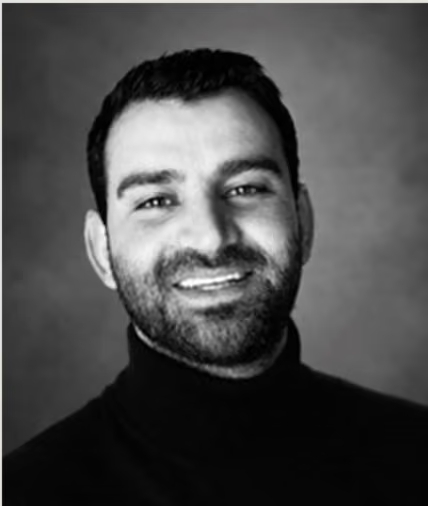
Who is Yassir Alomari
Most people see a city as buildings, streets, landmarks fixed points on a map.
Yassir Alomari sees lines. Even as a child, before he had words for perspective or composition, he was drawn to something underneath the surface the way one edge led into another, the rhythm between them, the structure holding it all together. He wasn't looking at objects so much as the space between them, the patterns nobody else seemed to notice. That way of seeing never left him. It's still where his work begins.
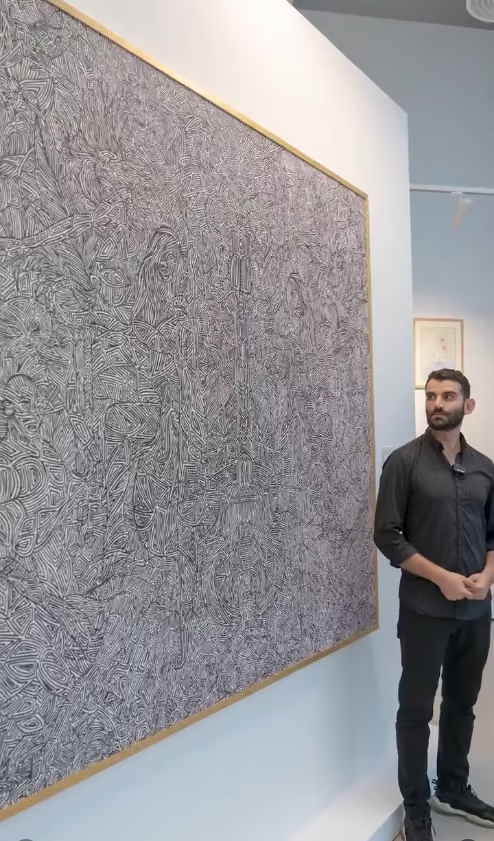
Across painting and sculpture, Alomari builds entire visual worlds out of thousands of carefully placed lines. What starts as repetition slowly becomes something else: movement, memory, a sense of place. The work asks viewers to slow down, to notice relationships they'd otherwise miss, and to see familiar landscapes a little differently.
Cities sit at the center of it all. He's less interested in documenting architecture than in the emotional life of a place, the memories it holds, the people who've shaped it, the invisible systems running underneath. Each painting works as both a map and a meditation on movement, on history, on what it means to belong somewhere.
His sculpture pushes that same exploration into physical space. Working with reclaimed materials, bicycle parts, old books, wood, found objects, he turns the everyday into something new, using it to think through transformation, cultural memory, and environmental awareness. The Go'oud series is a good example of this: the idea that materials, like cities and like people, keep carrying their stories long after their original purpose is gone.
For Alomari, drawing was never just a technique. It's a way of thinking, every line an act of observation, every composition another attempt to understand how people, places, memory, and time relate to one another.